

I don’t know who Sisyphus is. General information says that he was some Greek king in exile who had been punished by the gods to roll a rock on a mountain, but before the rock could reach the other side, everytime, would come back down rolling to the beginning point and he’d have to begin all over again.
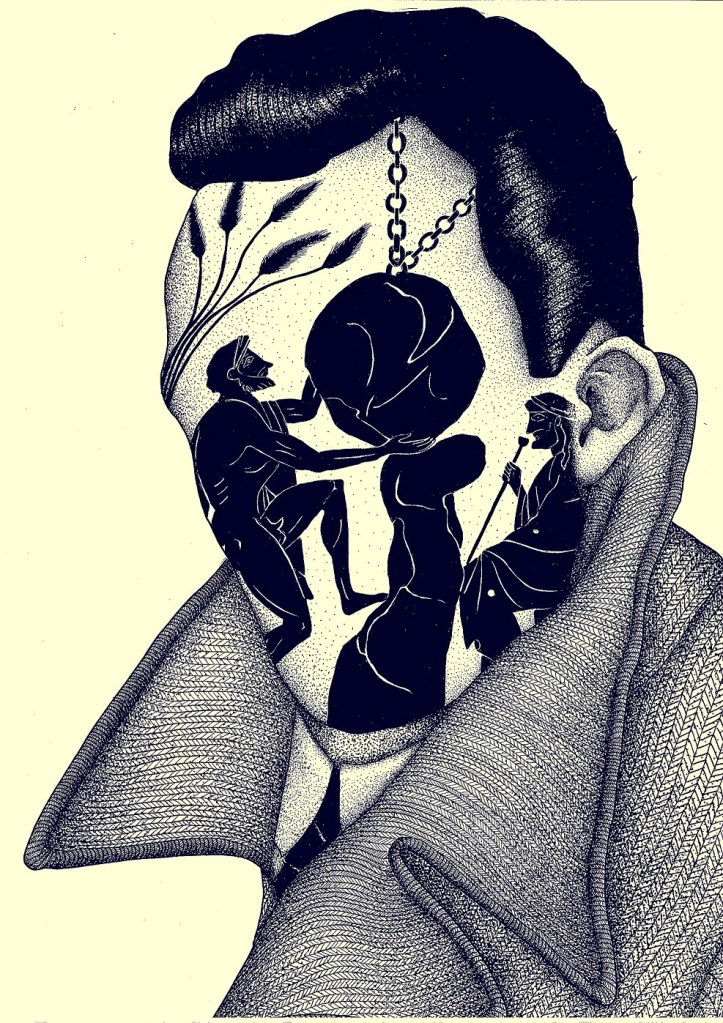
why did Albert Camus make Sisyphus famous?
Man loved myths, man was a French philosopher, man invented the phrase “one must imagine Sisyphus happy”, to which I add “one must imagine Sisyphus winning”. Now, what did he mean? pretty simple- that life has no inherent meaning and we are bound to repeat the same boring tasks over and over again throughout our life, but at least, to have the will to do so, we must find joy in the process. It also reflects the Hindu Philosophy of fulfilling your duties and not waiting for any reward. Now, my peers in academia will be extremely eager to find flaws in my definition and theory. But one thing I know for certain is that the success of Abraham Cowley’s odes was based on his misinterpretation of Pindar’s odes. Maybe I understand why Samuel Beckett wrote his play Waiting for Godot in French- that is to avoid the Anxiety of Influence (a term coined by Harold Bloom)- he did not want to worry while writing if his individual talent is following the long glorious traditions of English Drama or not. Okay, looks like someone got lost in their stream of consciousness . Anyway, how can I connect this all together? This philosophy of Camus has given birth to a school of thought named Absurdism. Absurdism is nothing but the belief that life has no meaning or purpose (I sound like Sadh guru with all this “nothing but”). And from all the bits of pieces of literature that I have mentioned in this paragraph, Waiting for Godot is one such text that flashes out Absurdism- In the play, we are given a time: a certain day and it’s yesterday and tomorrow, a place: a land with a drying tree, the land might be anywhere, and action: waiting. Yet, nothing happens.
Martin Esslin in his Theatre of the Absurd writes how when this play was first staged, a bunch of erudite theatre goer audience was heavily disappointed in the play as they expected the play to have a deeper meaning-which it lacked, but on the other hand, in 1957 when the play was staged before a bunch of prisoners, they could relate to it. Perhaps it was the endless waiting that had drawn them in, or the lack of intellectual show-off. However, the interesting thing is , in Camus’ own absurdist novel The Outsider, the protagonist, Camus’ ideal ‘absurd man’ Meursault, by the end of the play, finds himself in the prison, waiting to be executed. The absurd man according to Camus is the man for whom life holds no purpose or meaning, he who does not believe in divine existence or judgement, and is ‘amoral’- meaning that he is guided by his own integrity rather than the moral codes set by the society. This amorality might lead to the commitment of ‘crime’ by the absurd man (as when Meursault kills the Arab) and might also be the reason why many prison convicts found Godot easier to comprehend than the learned men- to them, the absurdity made sense.
Why did absurdism emerge?
Many reasons. As a response to Sartre’s Existentialism, the growing self awareness of man in this rapidly changing modern world, and one thing that I could comprehend to be the main catalyst is the first and the second world war. Pre world-war man had a blueprint of his life: the pre-Darwinian man would be driven by his divine duties, and a bit more skeptical post-Darwinian man would be driven by his moral and social duties. Suppose you wake up today, you have in interview in 2 hours, this interview is very vital as it determines your livelihood, you are prepared to give your best….and suddenly a war breaks out! by the time you get a grasp of what’s happening, the whole company building is turned to a heap of dust. That makes us question how much of in control of our own lives are we truly?(the closest to this uncertainty I’ve experienced in COVID 19 personally. But let’s not forget that while I’m writing this inside my airconditioned room, half of the Palestinian population is wiped out from the face of this earth as Israel is engaged in committing genocide.) A world where individual life has no meaning and neither can we say that it’s up to the individual to direct it’s course, is truly absurd. So can Sisyphus truly be happy always? nobody can say for sure. Remove Sisyphus from a certain time, situation, and place and he is free to be happy. But rolling the rock in a certain time and space was his punishment. Now let’s take a look at his situation: a punishment that required groundbreaking work but also gave him time to introspect. Now what if he had been sent to a Nazi concentration camp instead, as a punishment- I’d argue how inhumane it is to imagine him happy in that situation. so there is the crux, one must face the absurdity head on but also is ‘happy’ truly a sensible word to use in certain contexts? However, it is what it is. If or when one has the liberty to think in the first place, then one must imagine Sisyphus happy.
Then why do I imagine Sisyphus winning?
Recently in a friends group chat, I playfully remarked, “While some call it the law of attraction, I prefer to call it healthy delusion.”( It reminds me of that white-haired guy who, despite repeatedly saying “Nah, I’d Win”, found himself sliced in half. It’s a witty example that aligns with Aristotle’s philosophy of fate versus free will.) This tagline is an invitation for those enthusiastic about the law of attraction and readers of books like “The Power of Your Subconscious Mind” to consider exploring genuine philosophy instead of pseudoscience.
By the way, if you’re interested in delving further into Absurdist fiction, I’d recommend not only the well-known figures like Camus, Beckett, and Ionesco but also the captivating works of Franz Kafka, who happens to be your favorite “insect guy.” His writings offer a unique perspective for those seeking to explore the realms of Absurdist literature.
 Addie
Addie 